
Insights
20+ Years of Our Thoughts
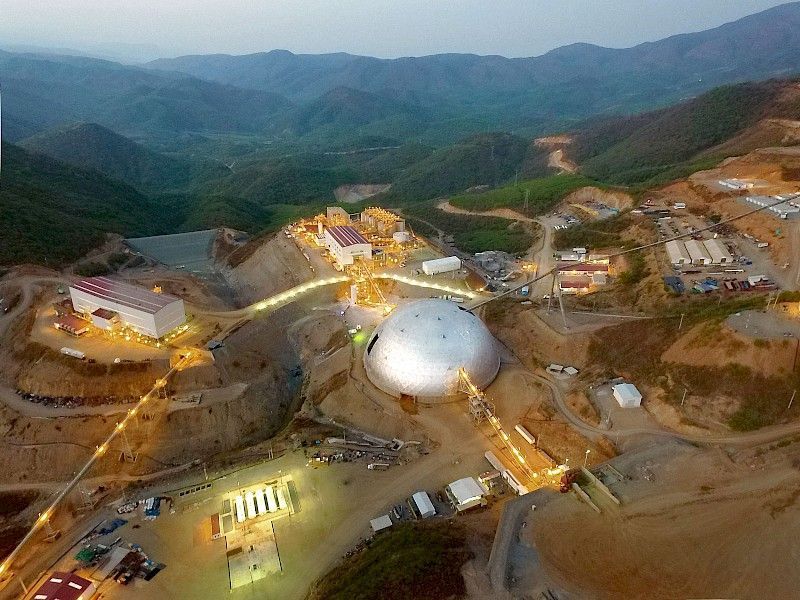
Dear Partners and Friends, PERFORMANCE Equinox Partners Precious Metals Fund, L.P. declined -6.0% in the second quarter of 2026, finishing the first half of the year up +1.3%. By comparison, in the second quarter, the price of gold declined -16.% and the MVIS Junior Gold Mining Index sold off -16.9%, finishing the first half of 2026 down -7.2% and -14.1% respectively. Performance for the quarter was driven by our exploration stage portfolio which in aggregate declined -9.3% amidst the declining gold price backdrop. Our portfolio of producing stage companies held up much better, only selling off -6.5%. Our largest producer, Solidcore Resources, was actually up +6% in the quarter. The portfolio also benefited from slightly elevated levels of cash, averaging 6% weight, which we were able to deploy part of as shares of our preferred companies returned back to our target IRR levels. Corporate Governance Corporate governance analysis is central to our research process. We view our long-term investments in publicly traded companies as partnerships with a company’s board of directors. Accordingly, we don't just want to know what decisions a board is making; we know why a board is making decisions. In our opinion, understanding a board’s motivation is the best way to gain durable insight into their corporate strategy and capital allocation policy. Our emphasis on corporate governance has helped us avoid value traps and understand our portfolio companies better. Active engagement is more than informed proxy voting. Active engagement entails a sincere dialogue with directors. While the relationships required for an honest back and forth are not easy to achieve, conversations with directors have become a real differentiator for our research process. Our corporate governance successes have added meaningful value, and our corporate governance failures have taught us important lessons. While each governance situation is unique, we face several recurring problems of note: Non-aligned directors: A surprising number of public company directors own little to no stock. These non-aligned directors fall into two categories: directors who lack sufficient wealth to own a meaningful amount of stock, and wealthy directors who choose not to own shares of the company that they govern. Both situations are problematic. Excessive executive option issuance: Ironically, the largest option grants tend to go to entrenched insiders that don’t need a payment to stay. As the interests of insiders and shareholders are clearly opposed in these cases, it is important that shareholders aggressively oppose excessive option issuance. Bundled voting: The sole purpose of bundling director elections is to reduce shareholder influence. The practice is gaining traction in Brazil, and we are actively opposing the trend. Stakeholder Capitalism: A theory typically used by boards to advance liberal environmental and social agendas that are at odds with shareholder interests. The resulting extreme ESG commitments can be both costly and morally objectionable. Poison Pill Adoption: While there are valid reasons to adopt a poison pill, most of the time they are used to further entrench management and boards and should be opposed by shareholders. Change of control payouts: An egregious practice of paying insiders an additional bonus to sell the company. Such payments are indefensible and the wrong way to address the problem of entrenched insiders. Corporate governance engagement is an art that goes well beyond the application of a set of rules. We don’t vote against every flawed director or proposal. Instead, we seek to explain to board members why we oppose certain practices and expect a good faith effort from them to address our concerns. We aim for improvements, not perfection. Corporate Governance Insights Applied The CEOs of Torex Gold Resources and B2Gold both announced their resignations in February of this year with gold trading north of $5,000 per ounce and gold mining equities indices hitting new highs. At both companies, the boards decided to promote the CFO to the open CEO role. In our opinion, these decisions reflect the boards’ intentions to prioritize the return of capital over growth strategies. Given the low valuations at which Torex and B2Gold currently trade, returning capital via share buybacks is especially accretive today. Accordingly, in both cases, the surprising leadership change made the companies more attractive investments, and we have been active buyers of both in recent months. Torex Gold Resources On February 4th, Jody Kuzenko, Torex’s CEO, announced her resignation. Given that Jody is 56 years old, the market was surprised by her unexpected departure, and Torex’s shares gapped down -12% on the news. If everything were fine, why would Jody leave the company she worked so hard to build over the previous decade? As long-term investors in Torex, we were in a great position to form our own opinion about Jody’s departure. Our conversations revealed two important things: First, Jody’s departure was a result of her sincere desire to take her career in a different direction and not the result of a problem at Torex. Secondly, Torex is going to generate an enormous amount of free cash flow, most of which will not be reinvested in mining activities, and Andrew Snowden, Torex’s CFO, is the right person to manage the capital return program. B2Gold On February 24th, Clive Johnson announced his resignation as the CEO of B2Gold. Given he was 73 years old, his retirement was not as surprising. Clive was a gifted CEO but not a fan of returning capital to shareholders through dividends or buybacks. Accordingly, his resignation drove B2Gold up 13% over two trading days. In our opinion, the stock market was rightly concerned that Clive would always push to build or buy another mine. Clive’s departure and the elevation of Mike Cinnamond, the CFO, provides clarity on B2Gold’s capital allocation framework going forward. The company is clearly focused on “per-share” value creation, which has resulted in increased share buybacks and dividends. Conclusion In both cases, the boards of Torex and B2Gold are prioritizing shareholder value over the “growth at any cost” mentality that has plagued the mining sector for decades. Our corporate governance engagement with these two companies provided us with a front-row seat to this important change that has not been fully appreciated by the market. Organizational Update In May, we added Roman Fuzaylov to our investment team. Roman has 20 years of experience as an investor across frontier and emerging markets. He started his career as a junior analyst at Prince Street Capital in 2006 and eventually became a partner and portfolio manager of their Tamerlane Fund, a regional mandate focused on Emerging Europe, Middle East and Africa. More recently, he was a co-portfolio manager of the Helios Seven Rivers Fund, a joint venture with Helios Investment Partners that focused on public markets investing across the African continent. Roman originally hails from Uzbekistan, is fluent in Russian, and is very well aligned with our long-term, fundamental approach to investing. In April, we hired Luca Grandinetti as a junior operations analyst. In addition to providing versatile support across our operations and middle-office functions, Luca has been instrumental in our Firm-wide efforts to centralize and organize the data around portfolio company corporate governance during proxy season. Prior to joining us, Luca worked at the Mitsui Group and Mirador, Inc.
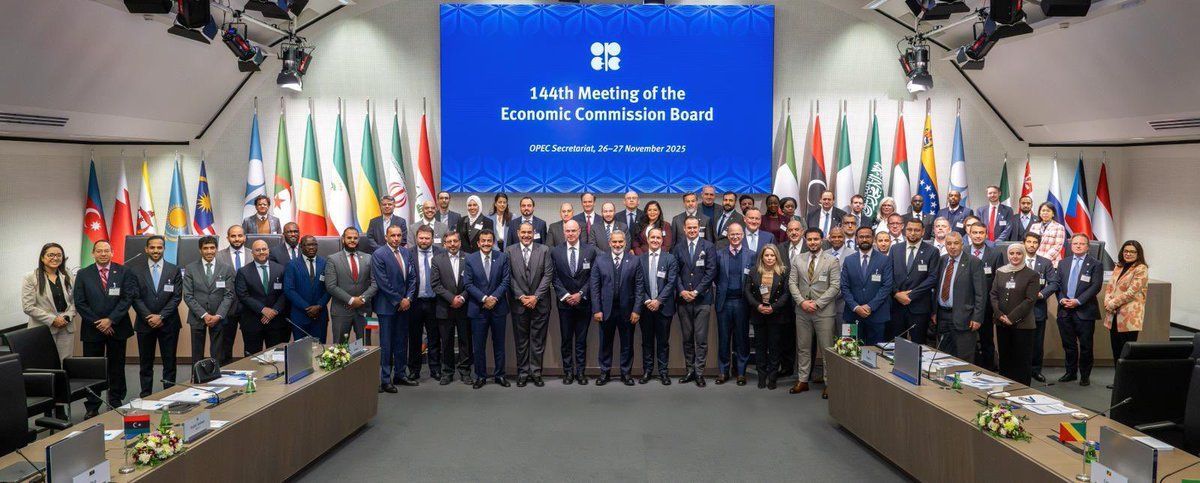
Dear Partners and Friends, PERFORMANCE Equinox Partners, L.P. declined (-12.4%) net of fees in the second quarter of 2026, finishing the first half of the year up +15.8%. During the second quarter, the S&P 500 index appreciated +15.2% and is up +10.2% through the first half of the year. Equinox’s poor performance for the quarter was driven by declines in both our mining and energy equities. Corporate Governance Corporate governance analysis is central to our research process. We view our long-term investments in publicly traded companies as partnerships with a company’s board of directors. Accordingly, we don't just want to know what decisions a board is making; we know why a board is making decisions. In our opinion, understanding a board’s motivation is the best way to gain durable insight into their corporate strategy and capital allocation policy. Our emphasis on corporate governance has helped us avoid value traps and understand our portfolio companies better. Active engagement is more than informed proxy voting. Active engagement entails a sincere dialogue with directors. While the relationships required for an honest back and forth are not easy to achieve, conversations with directors have become a real differentiator for our research process. Our corporate governance successes have added meaningful value, and our corporate governance failures have taught us important lessons. While each governance situation is unique, we face several recurring problems of note: Non-aligned directors: A surprising number of public company directors own little to no stock. These non-aligned directors fall into two categories: directors who lack sufficient wealth to own a meaningful amount of stock, and wealthy directors who choose not to own shares of the company that they govern. Both situations are problematic. Excessive executive option issuance: Ironically, the largest option grants tend to go to entrenched insiders that don’t need a payment to stay. As the interests of insiders and shareholders are clearly opposed in these cases, it is important that shareholders aggressively oppose excessive option issuance. Bundled voting: The sole purpose of bundling director elections is to reduce shareholder influence. The practice is gaining traction in Brazil, and we are actively opposing the trend. Stakeholder Capitalism: A theory typically used by boards to advance liberal environmental and social agendas that are at odds with shareholder interests. The resulting extreme ESG commitments can be both costly and morally objectionable. Poison Pill Adoption: While there are valid reasons to adopt a poison pill, most of the time they are used to further entrench management and boards and should be opposed by shareholders. Change of control payouts: An egregious practice of paying insiders an additional bonus to sell the company. Such payments are indefensible and the wrong way to address the problem of entrenched insiders. Corporate governance engagement is an art that goes well beyond the application of a set of rules. We don’t vote against every flawed director or proposal. Instead, we seek to explain to board members why we oppose certain practices and expect a good faith effort from them to address our concerns. We aim for improvements, not perfection. OPEC's Last Stand The Equinox Partners upstream oil investments are great at $80 oil, good at $70 oil and reasonable at $60 oil. The 40% portfolio weighting in oil equities reflects our conviction that oil prices will be closer to $80 than $60. Our view incorporates the natural oil supply-demand balance as well as our confidence that this supply demand balance is not solely determined by market forces. Chief amongst those non-market forces is OPEC, an organization that we believe will fight to stay relevant. OPEC’s operating premise is that small changes in oil supply drive much larger changes in the oil price. Therefore, oil exporting countries should modestly restrict oil supply to maximize their revenues. China and America’s active management of the oil market in recent years poses a serious challenge to OPEC’s influence. Having successfully suppressed the oil price with a series of market interventions, America and China have no intention of retreating to a passive approach and hoping for the best. OPEC now faces a stark choice: prevent America and China from rebuilding their oil inventories or become irrelevant. Coordinated interventions intended to manage down the price of oil are nothing new. Oil importing countries launched the International Energy Agency (IEA) in 1974 to do exactly this in the wake of the 1972-1973 Arab oil embargo. Since then, the IEA has formally coordinated oil importing countries’ response to oil market disruptions and OPEC’s oil price manipulation. IEA members, like OPEC members, make certain commitments. Specifically, IEA member countries must maintain 90 days of oil inventory and have a demand restraint program capable of reducing national oil consumption by up to 10%. These commitments enable the IEA to coordinate inventory releases and suppress demand during a crisis such as an oil embargo or war in the Persian Gulf. Absent a crisis, the IEA relies on soft power to contain oil prices. The organization promotes oil alternatives, warns about climate change, and makes pessimistic projections about future oil demand. The IEA has not, however, coordinated direct oil price suppression as a regular course of business. During his first term, Trump followed the historic norms for IEA member countries. When he wanted the oil price down in 2018, he turned to OPEC, not the IEA. Trump famously telephoned Saudi’s crown prince, MBS, asking him to produce more oil. We don’t know exactly what concessions Saudi’s crown prince secured in exchange for the additional oil supply but, presumably, Saudi assistance came at some cost. The Biden administration, perhaps because of its poor relationship with Saudi Arabia, took a more aggressive approach to the oil market, and released 50 million barrels from America’s Strategic Petroleum Reserve in 2021. Biden didn’t seek Congressional authorization for this release, claiming he was just swapping current barrels for future ones. A sleight of hand for sure, but one that recognized America’s new status as a net oil exporter. After Russia invaded Ukraine, Biden was free to take additional measures. He declared an emergency and released an additional 180 million barrels from America’s Strategic Petroleum Reserve, promising to eventually replenish the oil stockpiles he sold, which he only partially did. Once Biden proved that oil price could be influenced through active inventory management, his strategy was certain to be copied. The Iran war offered America and China an opportunity to do exactly that. The US and China have released hundreds of millions of barrels of oil and refined product into the market since the start of the war with Iran. Beyond inventory sales, Trump has constantly talked down the oil price, promised a plunge in oil prices when the war ends, and encouraged additional oil production from Venezuela. The Chinese have taken even bolder action, cutting their domestic demand by millions of barrels a day. While it is impossible to know how much of the Chinese demand reduction is actual demand suppression and how much of it is Chinese inventory sales, the estimated 3-5 million barrel a day decrease in Chinese oil demand since the Iran war started has helped keep a lid on oil prices. While there is no formal coordination between the US and China, the shared interest is clear. Both countries are highly indebted and want low oil prices to contain inflation expectations and domestic interest rates. Combined, the US and China have $45 trillion in federal government debt and another $80+ trillion in private sector debt. A little oil price manipulation probably seems like a small price to pay for the lower financing cost of debt. Low oil prices also serve America and China’s geopolitical interest vis-a-vis Russia. From the US perspective, low oil prices make Russia more likely to do a deal in Ukraine. From the Chinese perspective, low oil prices make Russia more dependent on China. In both cases, American and China clearly believe their geopolitical interests are served by lower oil prices. OPEC has long worried that large oil inventories in oil importing countries could be used to blunt OPEC’s influence over the oil price. America and China’s actions confirm that fear. OPEC is losing members, losing power, and now has a very difficult task ahead: if OPEC wants to stay relevant, OPEC must prevent America and China from restocking their inventories when the straits of Hormuz reopen. This will require carefully managed OPEC oil production and tough conversations with China and America. If OPEC succeeds in reasserting their position in the oil market, the oil market won’t get the full benefit of short-term oil restocking in the US and China. But, longer-term, OPEC’s relevance should ensure oil prices of at least $80. If, on the other hand, OPEC doesn’t reassert itself, China and America will restock their oil inventories quickly, which is short-term oil bullish. Then, China and America will use their excess oil inventories to manage down the oil price, which is long-term bearish.

Dear Partners and Friends, PERFORMANCE Kuroto Fund was up +3.5%, net of all fees, in the second quarter of 2026, and finished the first half of 2026 up +32.0%. By comparison, the MSCI Emerging Markets Index returned +24.2% in the quarter and finished up +24.0% for the first half of the year. The MSCI Frontier Markets Index was up +11.2% in the second quarter and up +10.2% for the first half of 2026. Performance in the second quarter was led by strong returns of Guaranty Trust, MTN Ghana, and UAC Nigeria, the last of which we will discuss in greater detail in this letter. These significant gains in our largest African equity holdings were partially offset by the pullback in several of our energy sector holdings. Our portfolio also suffered from the continued sell-off in the Brazilian equity market. We are using this weakness as an opportunity to deploy capital countercyclically into a handful of world-class businesses. Revisiting UAC Nigeria We recently returned from a trip to Nigeria and Ghana where we visited the management teams of several of Kuroto Fund’s long-term investments. One of those investments, United Africa Company of Nigeria (UACN), has appreciated significantly, entering the top 5 by position size for the first time. Given the meaningful contribution to return and large position size, we thought it would be timely to review the investment and learnings from our latest site visit. In the 1920s and 1930s, Lever Brothers Limited established the United Africa Company to facilitate trade in the region, mainly supplying palm oil for their soap operations. In 1974, the Nigerian subsidiary UACN became one of the first publicly listed stocks in the country. Today, it is one of the premier Nigerian companies with an iconic headquarters in Lagos. In the 1990s, Lever Brothers Limited, now known as Unilever, fully exited its shares and UACN diversified into several unrelated businesses, including property development, snack foods (sausage rolls and ice cream), paint, animal feeds, restaurants, and logistics.
VIDEOS
Featured research room Video
Visiting Vaca Muerta with Rafa Mendoza (July 8, 2026)
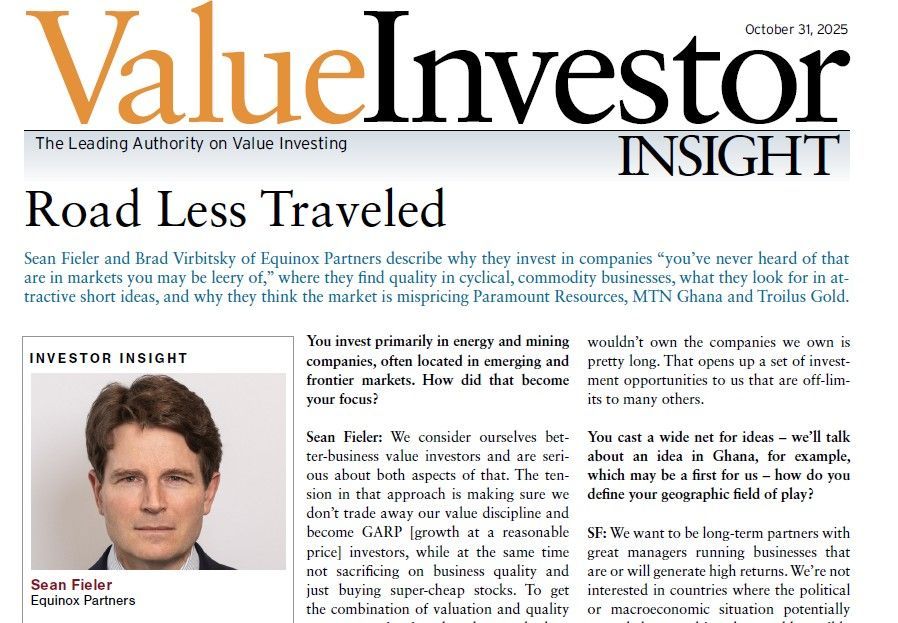
Value Investor Insight Profile with Sean Fieler and Brad Virbitsky
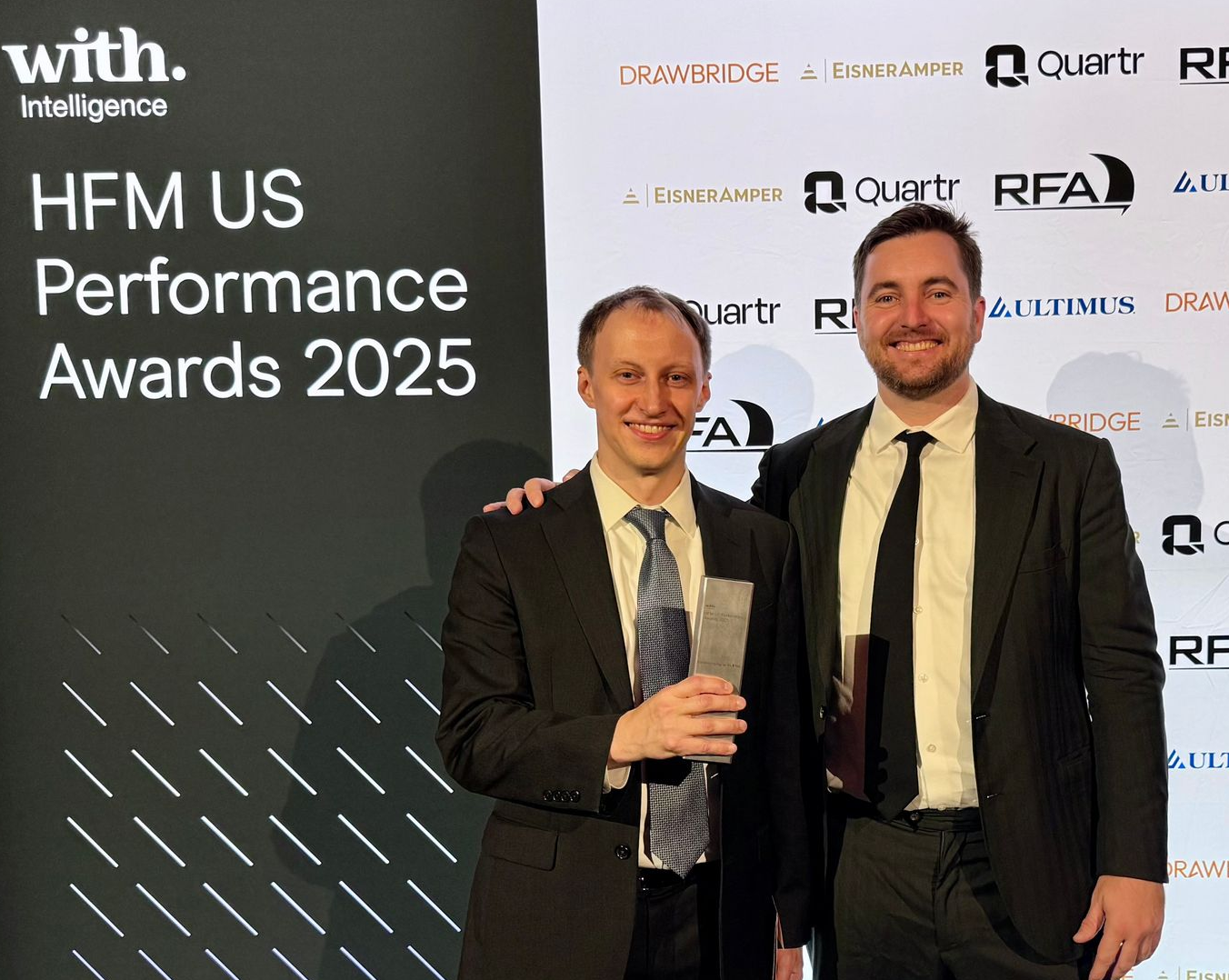
Kuroto Fund Wins HFM 2025 US Performance Award
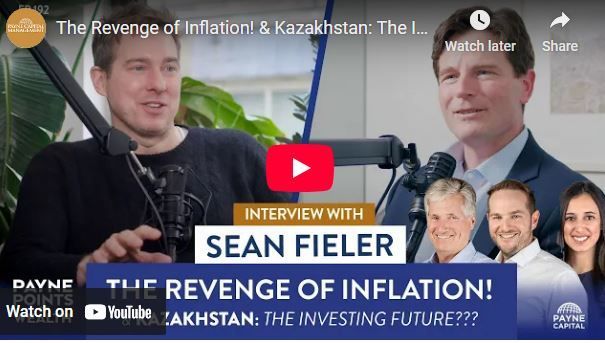
Payne Points of Wealth Podcast - "The revenge of Inflation and Kazakhstan"

Webinar Replay of Case Study presentation on Solidcore Resources
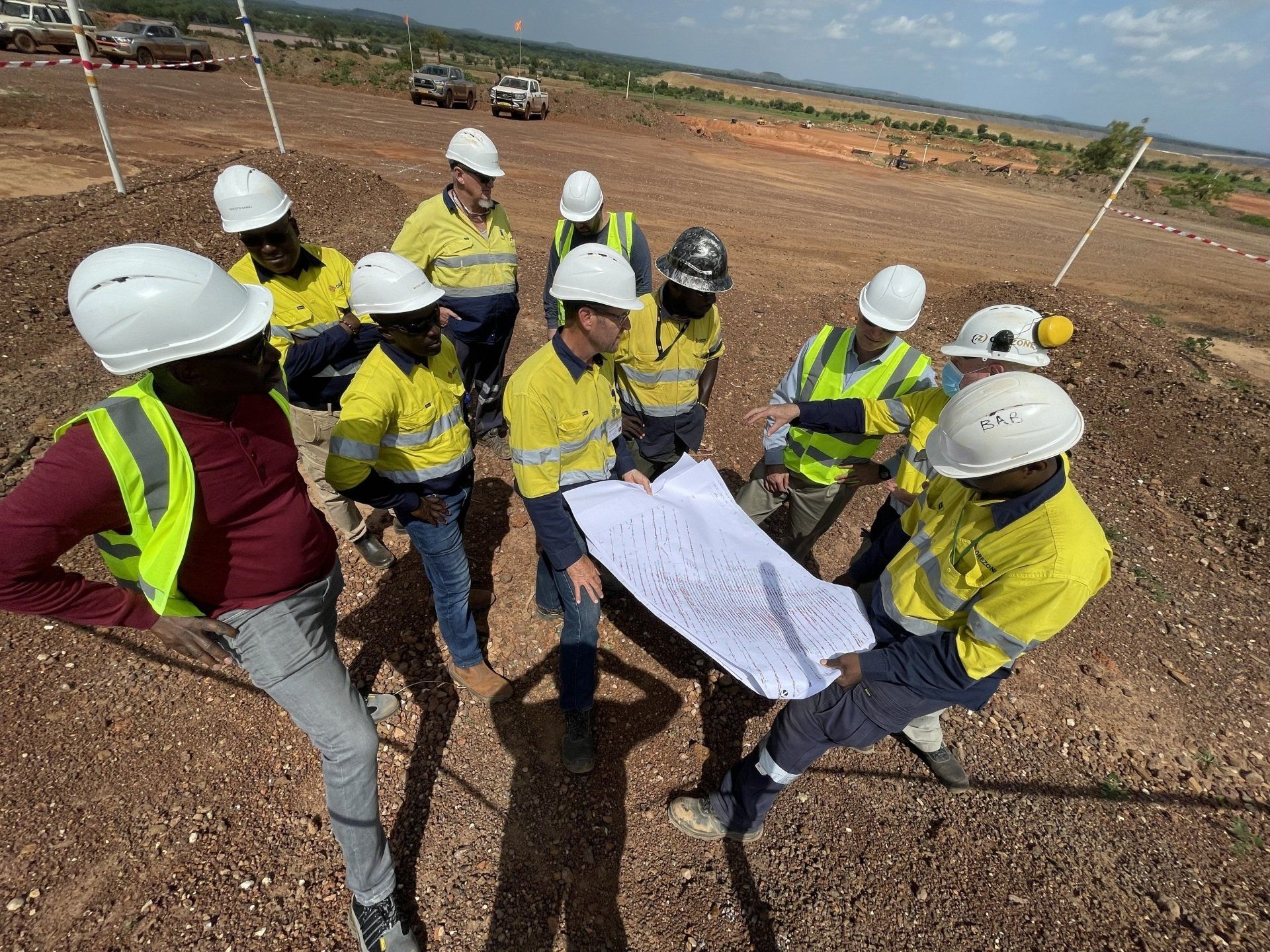
EQUINOX PARTNERS - Precious Metals Miners Site visit - Orezone Gold Corporation july 2022 Note and Videos
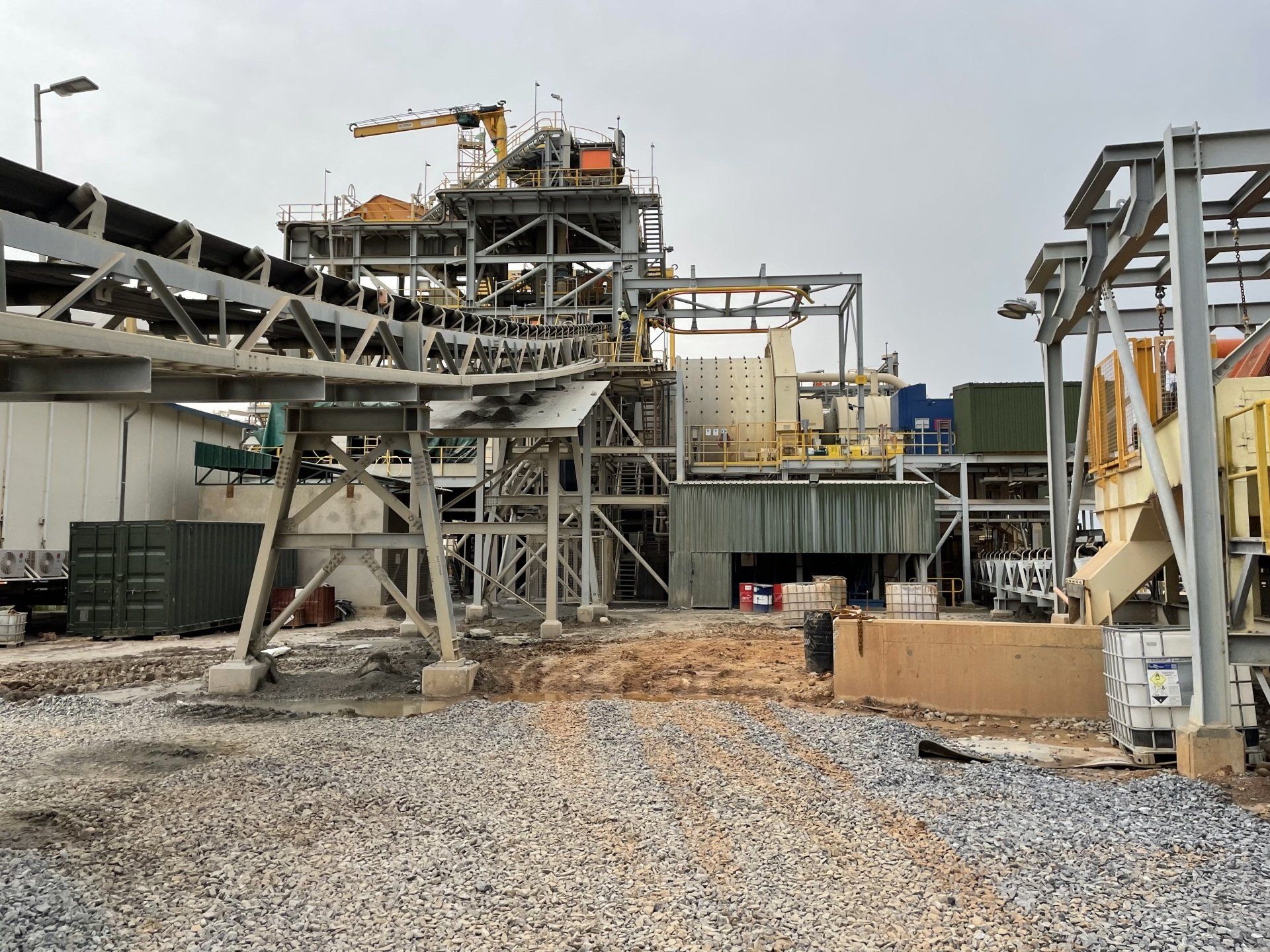
EQUINOX PARTNERS - Precious Metals Miners Site visit - west African resources july 2022 Notes and Videos